Thursday, July 4, 2024

All These Places Blanket

 Today I finished a knitting project I started over two years ago. 

That's a long time but it was, to be fair, the largest thing I've ever knitted.  A cotton blanket for my daughter.

Who kept getting taller, meaning the blanket had to keep getting bigger.

Here she is modeling it (she's almost 5' 10" now):

I used probably about 10 - 12 skeins of Cascade Yarns Nifty Cotton Splash 100% cotton yarn, which was MUCH nicer than any cotton yarn I've ever knitted with before.  Pricy, but worth it:


I used this pattern: https://www.fiftyfourtenstudio.com/knitting-patterns/all-these-places-blanket which I liked a lot.  My knitting is a lot looser, probably because it is cotton yarn.  But that's okay since the whole idea was to have a lightweight summer blanket.

I cast on 154 stitches and it is (sort of stretched out) 50" wide.  That would be 3 stitches to the inch which really is not what it looks like, so now I'm somewhat confused.  Eh.  

This was a therapy project.  I went through an extremely difficult time in my work life and I desperately needed handwork to help me stay present but keep my mouth shut during meetings, meetings, and more meetings.  Thankfully that is now much much better.

And as a bonus, it makes my daughter very happy.  Yay!


Friday, February 5, 2021

What White Kids Need to Hear

 Yesterday I read two books to my daughters (ages 8 and 11 right now):

Yours for Justice, Ida B. Wells: The Daring Life of a Crusading JournalistYours for Justice, Ida B. Wells: The Daring Life of a Crusading Journalist by Philip Dray
and Ruth and the Green Book


Both are good resources and I recommend them.  Note: we didn't read these because it's Black History Month.  We picked the one about Ida B. Wells randomly from the library and the one about the Green Book is a resource for a year-long anti-racism curriculum I was editing for work.

I don't think anything in these books was completely new to either of my kids.  This is stuff we talk about all the time as the opportunity arises.

But afterwards, a while afterwards, my 8 year old turned to me and said, "Mom, were there White people who didn't think slavery ... who didn't think segregation was okay?"

And I said, "There were lots of White people who if you asked them would have said that slavery and segregation were wrong.  But they wouldn't necessarily have said or done anything to change those things, or been willing to stop benefiting from them.

There were lots of White people who didn't see anything wrong with slavery or segregation and were happy to keep benefiting from them.

There were some White people who even worked to keep slavery and segregation going.

But there were also some White people who worked to stop slavery and to end segregation."

This is something White kids need to hear.  They need to know these truths.

But then I went one further.  I said, "In our family, your great-grandma and great-grandpa moved into the house that they lived in when I was a kid.  That neighborhood was all White.  No Black people lived there.  And then some things started to change and it became possible for Black people to buy houses there.  A lot of White people moved away from the neighborhood.  There were realtors who came and knocked on my grandparents' door and told them they should sell their house right away because a bad thing was happening and Black people were moving into the neighborhood.  My grandparents said no.  They liked their house and they liked their neighborhood and they were just fine with having Black neighbors.  It wasn't a really big thing to do.  They didn't help change any laws, although I think they were part of a neighborhood organization that got together specifically to defeat that kind of red-lining and scare mongering.  They just did the right thing in the situation they were in and refused to be scared of having Black neighbors.  Sometimes you don't have to do anything really BIG to make a difference.  Just the right things."

That is also something White kids need to hear.  They need to hear the truth about where their own family story fits with the stories of slavery and segregation, abolition and civil rights.  This happens to be a truth in our family history, but it is not the only truth (go back 50 - 200 years and there are a lot of different ancestors in different places in relation to race relations) and as circumstances allow my kids will hear other truths - like that many of my great-grandparents would have used the N word with no second thoughts, that we have ancestors who were probably slave owners (in a small way - no big plantations as far as I can tell), etc.  

And they need to hear that you start where you are, with the situations you encounter.  And you do the right thing to the best of your ability.  And that doesn't make you exempt from living in a culture of White supremacy, but that you always have the "right to choose which side / shall feel the stubborn ounces of [your] weight." (Bonaro W. Overstreet)

Monday, June 1, 2020

Navigating Decisions: Moving to Yellow

I offered a community workshop for families considering how to change their quarantine behavior as our area moves towards Yellow in the next week.

Here's the link to the recording:  https://youtu.be/CmOSKxFbpDs

I am suggesting these articles as follow-up reading because they've been helpful to me.  In this very unusual time, we are all trying to find our ways and figure out what the next best thing we can do is.  


And here's the link for the article we discussed in the workshop: 

Friday, April 24, 2020

Leg Warmers (instructions)

My 7 year old wanted leg warmers.  She had some pretty specific requirements, some of which, I decided after some experimentation, were not attainable.  I also chose the yarn myself because part of the point of this project was leg warmers and part of the point was 'something to occupy my hands during meetings'.  Which became EVEN MORE IMPORTANT when suddenly all meetings were happening via Zoom.

Although in the end a lot of these were knitted during births, too.

This is the yarn I chose, from Wild Hand in Mt. Airy.  They were very helpful in figuring out what I wanted and then they wound it into a nifty ball for me.


This was a very improvisational 'pattern' with a lot of false starts before I hit on what I really wanted to do.  I used No 6 4.0mm bamboo double pointed needles.  I divided the yarn into two balls before I started so I wouldn't make one fabulous leg warmer and then run out before I made another one complete.


  • Cast on 30 st and k2p2 in the round 20 rows.
  • Switch to k only and knit in the round another 20 rows.
  • Start adding 1st by knitting into the front of the stitch, and then into the back of the stitch before slipping the stitch, every other row. I just sort of varied where in the round I was doing this, so it's a bit random.  Add a total of 10 stitches, ending up with 40 st on the needles.  
  • Keep knitting in the round until you feel like you are almost out of yarn or it's long enough for your child's leg.
  • Switch to k2p2 in the round 20 rows.
  • Cast off!
The results:


I made them extra long in the hopes that she'll be able to wear them for a few years.  She is thrilled!

Saturday, March 21, 2020

Keep Going

There is a moment
when the path you are on 
ends;


all the ideas
and plans
and expectations you had
don’t make any sense,
not anymore.


You were a dot
moving in a line
on a plane.


Suddenly,
there are three dimensions
and the way you must go 
is up
out
away 
from the plane 
you used to know
was everything.


A Jacob’s ladder
leading up into the blue,
often through a storm
into heights 
with no air to breathe.


You may struggle 
for a time.
Want to go back,
need to mourn,
be angry,
shout at the sky.


And then you keep going.
It’s the only thing
you can do.


Keep going.
Become the person
you have to be
to do that.


Keep going. 
We are with you.


image Balu Ertl / CC BY-SA (https://creativecommons.org/licenses/by-sa/4.0)

Copyright Dawn Star Sarahs-Borchelt 2020; may be used freely for any non-profit use including streaming with credit.

Wednesday, January 22, 2020

Songs

Two songs have come to me in my life.

This one came when I was 15 and feeling very afraid a lot of the time.  (I had been robbed at knife-point at my local regional rail station down the block from my house.)  This song helped me be less afraid.

Do you know how strong you are?
Do you know how beautiful you are?
That you shine like a star in the night?
That you blaze with your own light?

You can see me sing it here: https://youtu.be/K22StyCGHbI

The other came the fall both of my maternal grandparents died.  We sang it at their memorial services.

Bury my heart but not my love;
carry that with you wherever you go.
We bury your heart but not your love;
we carry that with us wherever we go.


You can hear me sing it here: https://youtu.be/yMB4Zg7FOks

Tuesday, November 20, 2018

When You Have More Than Enough

Once upon a time there was a family. Maybe this family had not quite enough to eat.  Or maybe they had just about enough. Or … perhaps they had MORE than enough.

You might not have been able to tell.  THEY might not have been able to tell. Sometimes it’s hard to tell if you have enough or not.  It’s hard not to want more or different things than you have.

In any case, this family came together one autumn day for a celebration.  A feast. A time of gratitude.

They gathered, as we have done, around a table.  There was food. There was drink. There were flowers to remind them of beauty.

And then there was a call from the gate outside their door.  

“Hello!  We’re hungry and thirsty and we see you have a feast.  May we come in?”

Well, the family didn’t know at first how to answer.

Who were these people at the gate?  Was it safe to let these people in? Did they have enough to share?  Was there room?

But they remembered.  

They remembered that most of them had come to this family, to this celebration, from someplace else.

They remembered that even they, who were there at that table, had not always been kind to each other.  There had been times when they hurt each other. There were still times when they made each other sad or angry or afraid.  There is no way to make life completely safe.

They remembered times when others had shared with them, even when the others might not have had quite enough of their own.  

They remembered when each new member of the family had been born, or come to stay, or married in.  They remembered that they had always found a way to make room.

And they remembered an old, old saying: when you have more than you need, it is better to build a longer table than to build a higher fence.

We have enough, they said.  We might have more than enough.  We are many, and strong, and we can hold a safe space here in our home for all who come.

And so they went out of their door and to the gate in the fence.  They opened the gate. They invited the people who were there in. Inside, they pulled out another table and made the space for these newcomers.  They covered it with a cloth. And the newcomers set upon it a dish full of something fragrant and delicious which was strange and wonderful to the family.  Everybody shared. And there was enough.

I want us to notice that we only heard one part of that story.  We heard the story of the people who were in the family in the house, ready to feast.  We didn’t hear the story of the people at the gate, wanting to come in. We don’t know who they are or why they are there or what they bring to the table other than the strange and wonderful food!  So when you hear other stories this Thanksgiving season, I want you to think about whose stories they are. And whose stories they aren’t. And what those other stories might have been.

Sunday, October 14, 2018

Resilience and the Fire

RESILIENCE - THE FIRE

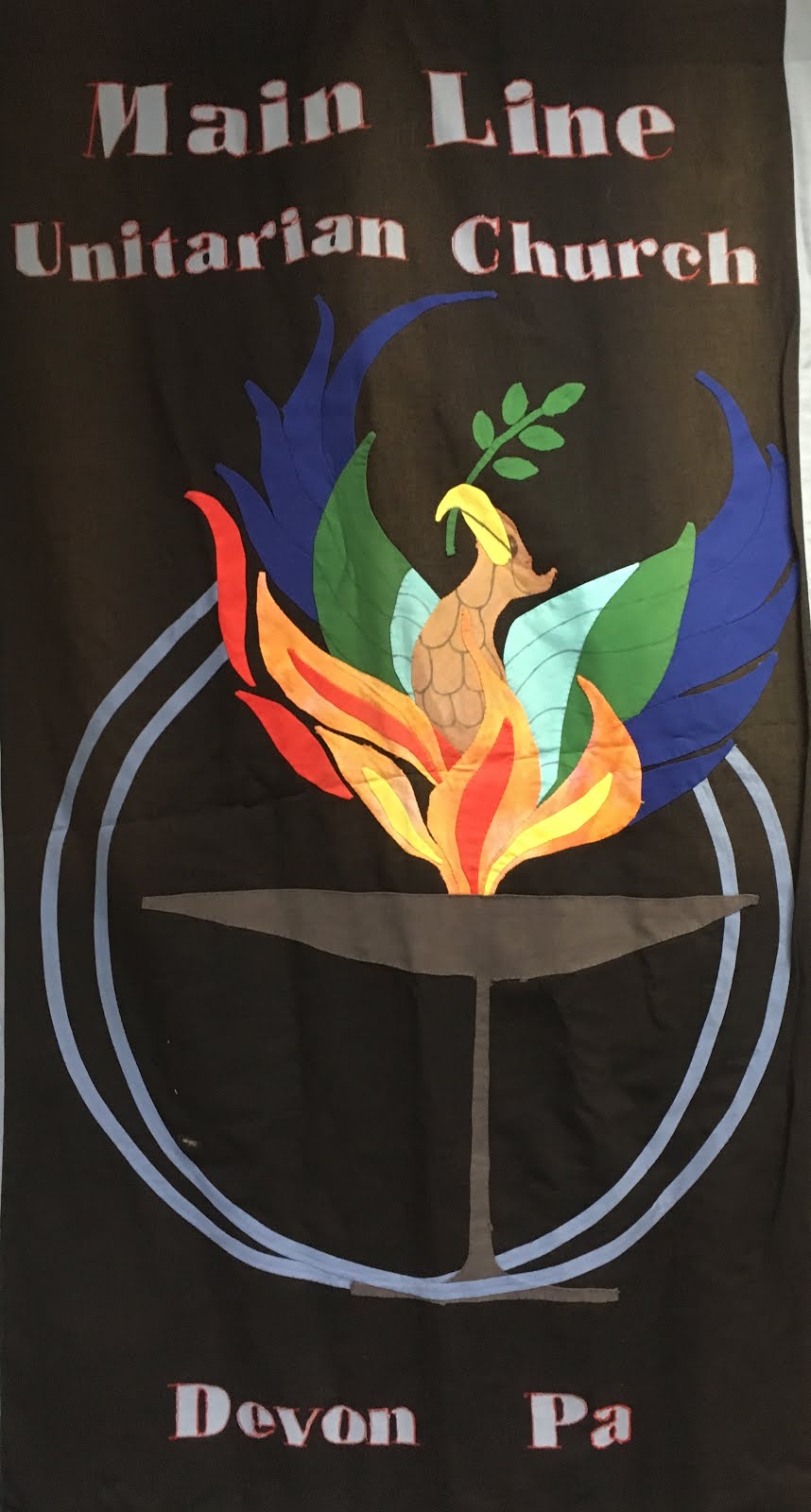
Main Line Unitarian Church began 60 years ago this year, in 1958.  But it didn’t start in its current building.


It started in a building about 3 miles away in Berwyn, which had been built by the Methodists. 


MLUC rented the building for a while, but then after only 2 years, they decided to buy this land, here, where we are now.


On this land was a mansion.  It had 17 rooms plus a ballroom big enough to seat 125 people.  It needed a lot of work, but within another year, the church opened its new doors.  And a few years later, when our congregation was 10 years old, they built even more space to hold their big, busy church.


But MLUC isn't in that mansion now.  The building now is only 26 years old, not 60.  Here is the story of why.


About thirty years after the congregation moved into the mansion, they decided they wanted to make their building bigger again, and fancier.  They raised lots of money and they hired a building company, and work began … and then disaster struck.


One night, a fire started.  As far as anybody could tell, it started in some old electrical wiring.  By the time anyone saw the flames, it was too late to save most of the old mansion.


The firefighters came - LOTS of them - and they sprayed and sprayed and sprayed water, but everything inside the stone walls burned.  Some of the stone walls themselves were damaged by the heat and had to be torn down later. Nobody could go into the building until the fire department said it was safe. The congregation certainly couldn’t come to worship or their religious education classes or hold meetings in the building.


Several things happened next.


One thing that happened was that MLUC was given help.  The Episcopal priest from the church just down the road came to them and said, “you can meet in our building for as long as you need to until you have recovered from this terrible fire!”


Another thing that happened was that members had to grieve what they had lost and plan what they wanted to do next.  There were lots and lots of meetings to talk about what happened and decide whether to re-build here or move somewhere else.


And finally, the congregation made a decision and moved forward to re-build.  


MLUC found out that their church was resilient.


When something is resilient it means that it can bounce back and keep growing even after something bad or damaging happens to it.


Some of us know what it’s like to be resilient, because something terrible has happened in our lives and we have gotten help, and we’ve grieved what we’ve lost, and we’ve made decisions and been able to move forward in our lives.  Some kids, some grownups.


Some of us maybe have had terrible things happen but haven’t been able to move all the way through them yet.  There is still time. Sometimes the process of becoming resilient takes a long time. But as long as you are alive, there is hope.  You can get help, you can grieve what is lost, and you can move forward, someday.


Maybe you have been really lucky, and nothing very terrible has happened to you. Sometimes resilience isn’t about dealing with one big terrible thing but just being able to keep going when little yucky or unhappy things happen.  


One symbol of being resilient is the Phoenix.  Some of you might know about the phoenix from Harry Potter, or from learning about mythology.  A Phoenix is a magical bird which is born from flame, lives its life, and then bursts into flames and turns into an egg - which hatches out a new Phoenix.


MLUC's church banner has a phoenix rising up out of the flaming chalice.  It shows that the building might have burned, but MLUC is still here and it is still a church with loving hearts, open minds, and helping hands.

Saturday, January 6, 2018

Choosing Books for Change (or At Least Common Decency)

Today at work I had occasion to go through a box of picture books, sorting out what to keep for our church library and what to get rid of one way or another.

Now usually, when I do this sort of thing, the 'get rid of' books go to the thrift store.

Today I found one that is not, in fact, going to the thrift store.  It's going in the trash, since it's a hardcover and I don't know that the binding would recycle particularly well.  And it's not because it's moldy or water damaged.  It's because it's horrifying.

Published in 1963, Fireflies in the Night by Judy Hawes, illustrated by Kazue Mizumura seems like a fun little old-fashioned book.


It has some neat factoids about fireflies.  It also has this illustration:

 That is a BIG NO.  People in Africa (and their descendants in the diaspora) are not bug-eyed apes and it's not okay to depict them as such.  I don't want anybody picking that book up to read at random and will certainly not be suggesting it for a story time about bugs, nature, or anything else.

Also going in the trash:  Little Hiawatha from Wall Disney Productions from 1978.

 This is full of fairly extreme and disrespectful stereotypes about Native Americans.  Also not something I want other people to come across.

There are a few books that will be going to the thrift store.  My criteria for keeping a book are:

  • Must have something to do with a topic we might have a class or worship service about (that is a pretty broad range of topics.)
  • If humans are shown, they must be a diverse range of humans (in terms of race, sex/gender, age, etc.) unless there is some actual reason connected to the story why not (for example, I don't demand that a story about a family necessarily include racial diversity within the family.)
  • Language should be at least respectful of the people it is referring to - I don't necessarily require the most up-to-date terminology at all times.
Going to the thrift store today:

Twinkle, Twinkle, Little Star and Other Favorite Bedtime Rhymes by Sanja Rescek, 2006:    This one has an all-White cast, for no apparent reason.  And I'm sure we have/there are much better, more reflective of human diversity, illustrated versions of nursery rhymes.

Spot Goes to the Beach by Eric Hill, 1985, is going to the thrift store because it's not terribly topical.  These books are fun, though, and they do make some attempt at artistic inclusion:

 Spot and his family and friends are a variety of colors, species, and have different abilities and interests.

All this made me think about really GOOD picture books and what I look for in them.

There are some books that are going all out for diversity and affirming each person for who they are, no matter what.  That's great!  An example I walked into my office and pulled off my shelf is It's Okay to Be Different by Todd Parr, 2001.  


That's not the only kind of book we want to have, though, because there are many stories in life and they are not all about being different.  Or even if they are, they don't all need to slam you upside the head with it.

There are lots of books that do a good job of showing diversity as something that just is, including Chrysanthemum by Kevin Henkes, 1991:

 In fact, this story is about diversity, feeling different, and feeling the same, but there are a lot of excellent books on lots of topics that set the norm that there are people of all sorts everywhere.  See how much variety there is in Chrysanthemum's classmates in how they look (white, gray, and brown fur) and who they are (different approaches to posing for a picture!)?  I have books that do a good job of this that are about construction and feelings and dance and all kinds of topics.

Finally, there are books that show one kind of person but they do that for a good reason, because the story is naturally about one type of person.  There are books about being deaf that show mostly deaf people using sign and hearing aids etc.  There are books about mommies that show mostly women (I'd love one that shows trans women as on the spectrum of normalcy, although I don't know that I have one ...).  And there are books that show people mostly or entirely of one race or ethnicity.  A good example is The Great Kapok Tree: A Tale of the Amazon Rain Forest by Lynne Cherry, 1990.  Since the vast majority of people who live in the Amazon Rain Forest have darker skin and many have mixed Native and European ancestry, I think this guy looks just right for this story:

Saturday, June 24, 2017


Higher Ground (by Stevie Wonder: https://youtu.be/mcwyyFOeu5E)

People keep on learnin'
Soldiers keep on warrin'
World keep on turnin'
Cause it won't be too long
Powers keep on lyin'
While your people keep on dyin'
World keep on turnin'
Cause it won't be too long
I'm so darn glad he let me try it again
Cause my last time on earth I lived a whole world of sin
I'm so glad that I know more than I knew then
Gonna keep on tryin'
Till I reach the highest ground
Teachers keep on teachin'
Preachers keep on preachin'
World keep on turnin'
Cause it won't be too long
Oh no
Lovers keep on lovin'
Believers keep on believin'
Sleepers just stop sleepin'
Cause it won't be too long
Oh no
I'm so glad that he let me try it again
Cause my last time on earth I lived a whole world of sin
I'm so glad that I know more than I knew then
Gonna keep on tryin'
Till I reach my highest ground...Whew!
Till I reach my highest ground
No one's gonna bring me down
Oh no
Till I reach my highest ground
Don't you let nobody bring you down (they'll sho 'nuff try)
God is gonna show you higher ground
He's the only friend you'll have around

"Do you want to speak...or do you want to be heard? Do you want to make a name... or do you want to make a difference? Do you care if you get credit or do you care if something gets done?" - Rev. Cheryl M. Walker (paraphrased from the Service of the Living Tradition, UUA General Assembly, 2017)

I care if I am heard, I care if I make a difference, I care if things get done.

Better Days

Better Days (Emma's Revolution: https://youtu.be/grB7TvT_6SM)

We have come in the light to this place in the light with our hearts in the light open wide.
We are here in the light giving voice in the light to the truth in the light we divine.

Let us sing for today let us learn better ways.
Showing love in the light giving hope in the light we create in the light better days.

We are born in the dark we are fed in the dark we connect in the dark through the veil.
We are held in the dark we are healed in the dark mysteries in the dark we reveal.

Let us sing for today let us learn better ways.
Showing love in the dark giving hope in the dark we create in the dark better days.

Time is now we begin where we are we begin we have all we begin that we need.
To renew we begin to release we begin to rebuild we begin to believe.

Let us sing for today let us learn better ways.
Showing love we begin giving hope we begin we create we begin better days.

I sat in the opening worship for the LREDA professional days and I felt the tears well up and wet my face.

I did not want to cry. I did not want my colleagues to see me cry.

But I could not stop the tears.

It has been 12 years since I attended a General Assembly or a LREDA professional day at GA.  And my inner Child wanted to know why.  She wanted to know why I had abandoned her by neglecting these professional and collegial connections for so long.

Once I could hear that Child's wailing question, I could accept it and answer it.

I chose mothering infants and toddlers for a cumulative 12 years with my eyes open.  For much of that time I had very good communal support from family and friends.  I chose to become a doula and childbirth mentor in addition to my religious education calling with my eyes open.  I had amazing support from my partner and connections in that community.  But in the last half of that time, my family was also impacted by financial and social pressures we did not choose but could not avoid.   External changes beyond our control pulled us into the underworld, made us walk a labyrinthine path of change.  I will not speak for my other family members or even about our path as a family except to say that it has been hard and long.

Yes, in a way the time I've spent focused intensely on raising my young children and coping with familial and financial pressures and developing another professional role entirely in another field was an abandonment.  In other ways, it was not.  My inner Love Warrior was able to reassure my inner Child that even when it didn't look like it, all of that time I was in fact working very, very hard to get myself back here.  This reassurance steadied me, dried my tears, and let me move forward.


Wednesday, June 7, 2017

Put your fears down on the ground


Put your fears down on the ground. 
Walk away. 
Turn around 
and look at them 
from a little way off;

maybe holding the hand of someone you love. 
Maybe you'll feel the (ghost) hand 
of your beloved grandmother, 
The one in whose eyes you could 
do no be no think no say no wrong. 

They aren't you. 
Think about that before
you decide whether to walk over and
pick them back up again. 

Consider whether 
one or two small pieces
might have melted 
into the dirt by now. 

Look up at the sky. 
Breathe. 

Even without those fears
held tight in your hands
your heart is still
beating, you are still
you.

Sunday, April 16, 2017

Easter, a Terrible Story about Hope

Once upon a time, there was a man named Jesus.


Who was Jesus?  He was a man. Probably a carpenter. A Jew. And in the world Jesus lived in, there were people with power and authority, and people without.

The Romans had armies and money and power.


The Jews did not. They were seen as different. They believed in a different God, they held strange rituals. The Romans were the ruling class and the Jews were a small, not very powerful minority.

But even in his own community, Jesus wasn't loved by everyone. Oh, he had friends, and he had followers. But he spoke truth to power. He made people uncomfortable. He said things should change, because things weren't okay the way they were.


He was scapegoated.


And he was killed.


This part of story is terrible. When I was a little kid, this story really bothered me. When Jesus is killed, that is a terrible, terrible thing.


Who are you in this story?  


Are you the hero?


Are you one of his friends?


Are you a bystander?


Are you the persecutors?


Are you someone who doesn’t even know this is happening?


So this is a terrible part of the story, and yet, terrible things happen. Every day. Every place. Throughout time. Things fall apart.


The rest of the story is about things that both do and DON’T happen every day, every place, throughout time.


In the story, Jesus is buried and after three days people who love him come to mourn at his grave and his body isn't there.


Then they see him walking around.


And he talks to them.


And they go out to tell everyone they can the GOOD NEWS that Jesus is risen.


They tell the GOOD NEWS that they believe that Jesus is part of God, and God has brought Jesus back from the dead into a new life.


They tell the GOOD NEWS that they believe that if anybody, no matter how sinful a person they are, believes that Jesus is part of God, then after they die, God will bring them back from the dead into a new life in Heaven.


This kind of thing doesn't happen in our ordinary lives. It's more like a superhero story. SUPER JESUS!!!


But it also does happen. Even when things have fallen apart, and people do terrible things to each other, even then there is hope. There are choices.


There are flowers that grow from tiny seeds and crumpled up dead looking bulbs.


There are beliefs that bring us hope and return us to life.  Even when life seems really terrible and hard.


We can choose to believe in hope.  Each of us, here, now, can choose to look for good news and share it. Sometimes, we can choose to help someone who is hurt or treated unfairly or not included. Sometimes in big ways. But we can practice for that in little ways.


I don't know if everything happens for a reason. I don't know if it makes sense to believe Jesus died to fix our mistakes. Sins are just mistakes. But I do believe we can learn something  from everything that happens. And the lesson I choose to take from what happened to Jesus is that when things fall apart, there is always the possibility that growth and new life will come after. And that I can be part of that possibility, if I choose to.